

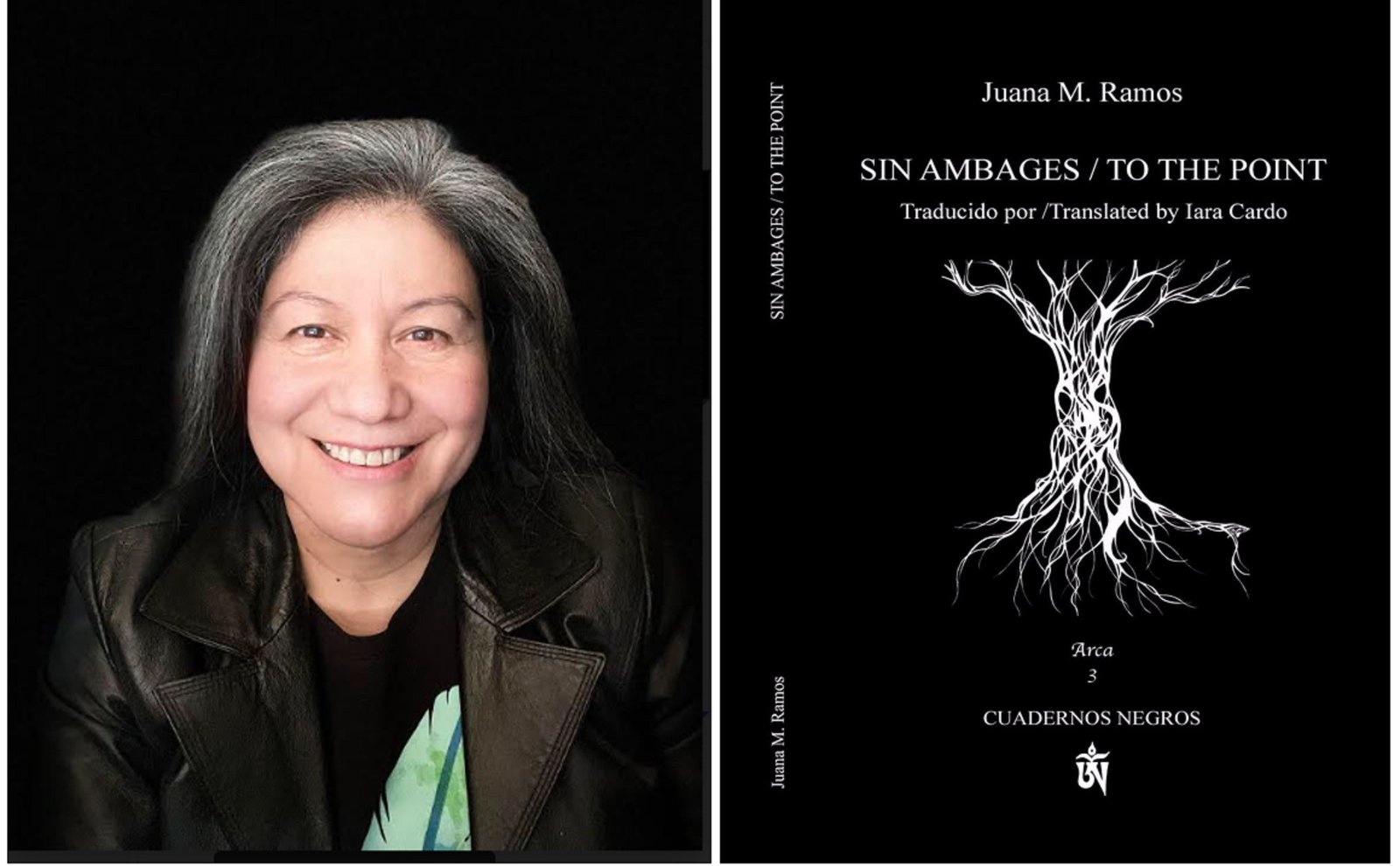
Interview by Mónica Sarmiento-Archer
The International Voice (La Voz Internacional) is inaugurating a series of interviews with Latin American researchers, artists, academics, and intellectuals, who live in or visit New York. From this center of Ibero-American cultural diversity, we echo the different voices that contribute to the development of this community. Spanish is reaching a great level thanks to intellectual publications, articles, and research that expands our understanding.
On this occasion, under the rain of the city, we are reflecting on the words of Juana M. Ramos (El Salvador). She is a professor of Spanish and Literature at York College of the City University of New York (CUNY). Ms Ramos has participated in international poetry festivals and recitals in Latin America, the US, and Spain. She has published Multiplicada en mí, Palabras al borde de mis labios, En la batalla, Ruta 51C, Sobre luciérnagas, Sin ambages/To the Point (2020), and Clementina (2021). She is coauthor of Tomamos la palabra: mujeres en la guerra civil de El Salvador (1980-1992) (2016), a collection of testimonies of women who fought in El Salvador’s civil war. Her poems and narratives have been published in several anthologies and literary magazines, both in print and digital format, throughout Latin America, the United States, and Spain. Her poetry work has been partially translated into English, Portuguese, and French.
IMSA. Can you talk about your homeland?
JMR. El Salvador is one of the countries that make up the Central American region. In the 1980s, it was plunged into a civil war that left some 70,000 dead and millions of exiled Salvadorans. In 1992, through the signing of the Peace Accords, the so-called post-war period began, in which there was an explosion of spaces devoted to the dissemination of national culture and literature. Although the news currently portrays a nation plagued by the scourge of social violence, it is important to make visible, in the case that concerns me here, that other face of El Salvador, the one in which a group of cultural workers who fight, from within and from the diaspora, for the construction of a society in which culture and education become priorities and accessible to the entire population. These cultural workers carry out their work from the margins, that is, through cultural activities, poetry readings and independent editorials, among other spaces. In the historical moment that the country is currently experiencing, in which the fragile and incipient democracy achieved after the end of the war is threatened, it is essential to educate the population, give them tools that allow them to make the current situation a category of analysis.
IMSA. Who is your poetry addressed to?
JMR. My poetry is addressed to all readers who, through reading it, manage to identify with it. I have always said, and this can be perfectly verified in my collections of poems, that I am not a poet who follows a strict thematic line. In other words, the poems that make up each of my books have different themes. I believe, and here I will borrow the words that the Cuban poet Minerva Salado wrote about my poetry, the thread that unites each of my poetic texts is poetry itself. As Roque Dalton said so accurately, “poetry is like bread, for everyone”.
IMSA. What is the role of poetry in society?
JMR. My life experience has taught me that poetry, «the word», has the duty to document, to record, to make visible everything that concerns us as a society. Its role is to show us «all the possibilities» of our particular stories and of History in general.
IMSA. What is your experience with Hispanic culture in New York?
JMR. I joined the New York social fabric in 1991, when I arrived in this multicultural and magical city (a city that can also, from time to time, show us its teeth). I did my undergraduate and graduate studies here in NY, which made it easy for me to network both in the cultural scene (as far as creative writing is concerned) and in academia. I have had the opportunity to meet people who work hard for culture and literature, and the luck of joining groups and spaces dedicated to showing that other face of Latin American immigration. I must say that, thanks to my work as a professor at the City University of New York (CUNY), I find myself daily, face to face, with the reality of my students, both, those born and raised here as with those who have emigrated to this city for various reasons. One of my purposes as a professor is to provide my students with contact with the cultural activities that take place in the city and in which I participate or get involved in various ways. Among these activities, I am interested in bringing them to book fairs, poetry festivals, talks, conferences, colloquia, and other forums in which topics about Hispanic culture in New York are exposed.
IMSA. Can you name contemporary poets that we may not know that you teach your students?
JMR. In my classes, I try to establish a balance with regards to the poets that I include, in particular, in the Introduction to Literature course. When I say seek a balance, I mean that it is my practice to develop a program that includes both, canonical and noncanonical poets. In the latter, I give way, for example, to Latin American poets who write in Spanish in the US, as well as Latinx poets. But here I am interested in bringing up the seminar on “Salvadoran Poetry” that I teach, and to which I give different approaches. One such approach is that of the poetry that was produced during the Salvadoran civil war (1980-1992). Here, I am interested in highlighting the poetry written by women. Among the poets we study in the seminar are Lil Milagro Ramírez, Claudia Patricia Jovel, Leyla Quintana, Kenny Rodríguez, Eva Ortiz and Silvia Ethel Matus. Around these voices, and the production of these poets in that period, we study the resignification of female subjectivity at a crucial moment in Salvadoran history. Another approach is that of the poetry produced in this period, where social violence prevails in the country, and how young poetic voices offer us their own interpretation and their own imaginaries, in very particular discursive registers, of the Salvadoran reality (in all its aspects and dimensions). Among those voices, I am interested in highlighting that of Kike Zepeda, Alberto López Serrano, Diana Castro, Jorge López, Fredy Mejía, Ana María Rivas, among others.
More information about poet and Professor Juana M. Ramos at https://www.york.cuny.edu/portal_college/jramos
Ines Monica Archer
Artist and cultural manager; teaches Spanish at Hofstra University and Aldelphi University, New York; Director, bi/Coa: Base Intercultural / Community of the Americas; PhD in Visual Arts, Universidad Complutense, Madrid; MA in Spanish, St. John’s University, New York